



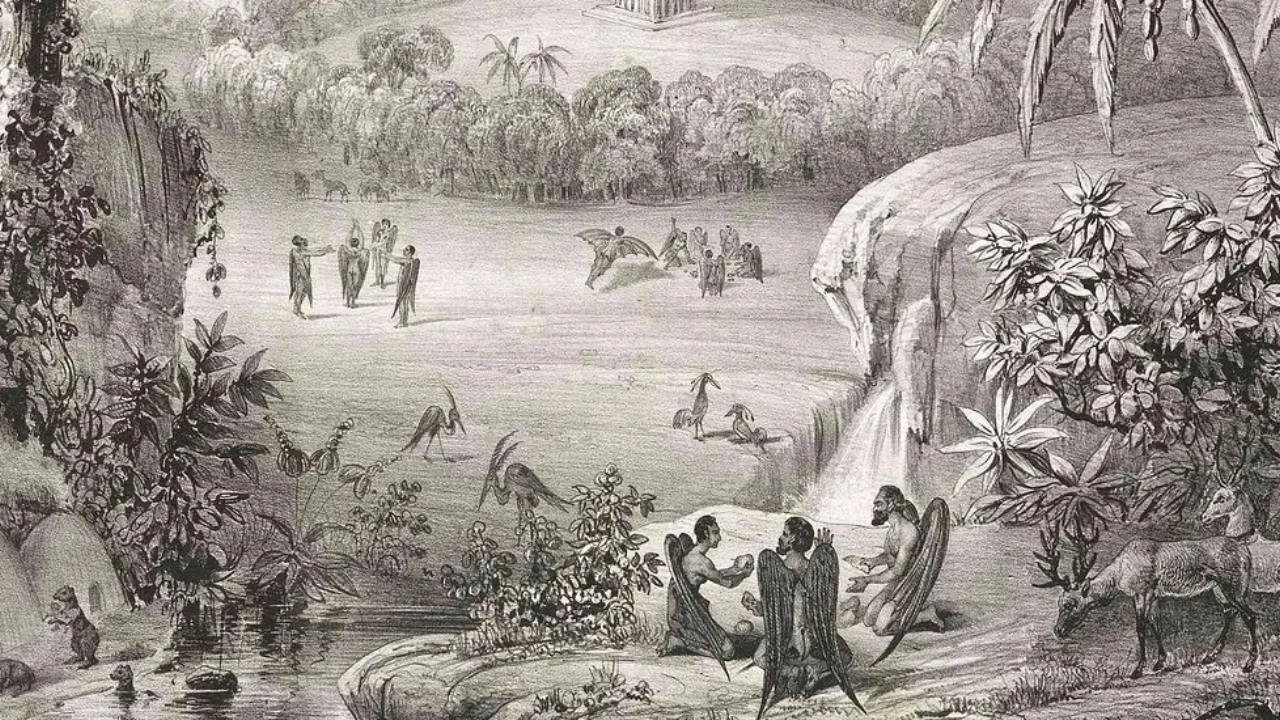
Once upon a time — August 1835, to be exact — the people of New York woke up to what might have been the most mind-blowing headline in history. According to The Sun newspaper, astronomers had just discovered life on the Moon! And not just any life — oh no, we’re talking about bipedal beavers, unicorns, miniature zebras, and, most famously, an entire race of bat-winged humanoids who built elaborate temples. It was the scoop of the century.
Except, of course, it was all completely made up.
The Wildest Moon Safari Ever Imagined

The story, which ran as a six-part series in The Sun, was credited to Dr. Andrew Grant, a supposed companion of the famous astronomer Sir John Herschel. The articles detailed how Herschel, using an absurdly large telescope (24 feet in diameter and weighing seven tons), had peered into the cosmos and found an extraterrestrial utopia.
According to The Sun, the Moon was teeming with life. There were vast oceans and lush forests. Bison grazed peacefully next to one-horned goats, while tailless beavers (which allegedly walked on two legs) built little houses like tiny lunar carpenters. But the real stars of the show? The Vespertilio-homo — literally, “man-bats.” These creatures, described as four-foot-tall humanoids with giant bat wings, were civilized, intelligent, and deeply religious, as evidenced by the grand temples they constructed.
The whole world was captivated. People flocked to newsstands, desperate to read the next installment. Scientists, clergy members, and intellectuals debated the implications. The Moon was no longer some cold, lifeless rock — it was a celestial zoo!
A Telescope Too Good to Be True
Of course, the story had a few… let’s say, scientific inconsistencies. For one, no telescope on Earth could possibly magnify the Moon enough to see tiny beavers setting up shop. But the article had an explanation ready: The telescope used a revolutionary new principle, so advanced that its workings were too complex to explain. Convenient, right?
Then came the grand finale — because every good hoax needs a dramatic ending. According to the paper, the observations were abruptly cut short when sunlight hit the telescope’s massive lens, turning it into a “burning glass” that ignited the observatory and destroyed all the equipment. A tragic loss for science! And an extremely convenient way to ensure that no one could double-check the data.
The Mastermind Behind the Madness
At first, nobody knew who had penned the lunar fantasy. Eventually, the truth came out: The articles were the work of Richard Adams Locke, a writer at The Sun. Locke finally admitted to the prank in 1840, though rumors persisted that others had helped cook up the scheme.

But why do it? Simple — newspapers in the 19th century were locked in an intense battle for readership, and The Sun was pioneering what we’d now call “clickbait.” The hoax boosted the paper’s circulation to unprecedented levels, permanently establishing it as a major player in the penny press industry. Plus, Locke allegedly intended the whole thing as a satire, poking fun at the outlandish astronomical theories of the time.
Not Everyone Was Amused
Sir John Herschel, the esteemed astronomer whose name had been hijacked for the hoax, was initially amused by the whole thing. After all, his real lunar observations were nowhere near as exciting as bat-men flying over temple ruins. But as time went on and people kept pestering him with questions about his “discoveries,” his patience wore thin.
Meanwhile, Edgar Allan Poe was not happy. The famous author claimed The Sun had ripped off his earlier (and, admittedly, less successful) moon-related short story, The Unparalleled Adventure of One Hans Pfaall. Whether Locke was inspired by Poe remains debatable, but one thing’s for sure: the hoax completely overshadowed Poe’s work, and he wasn’t thrilled about it.

The Lasting Legacy of Lunar Lies
Despite eventually being exposed as fiction, the Great Moon Hoax remains one of the most fascinating moments in the history of journalism. It highlighted how eager people were to believe in the extraordinary, especially when it came wrapped in the authority of science. It also set the stage for the kind of sensationalist journalism that would later evolve into tabloids — and, in a way, modern-day viral hoaxes.
So next time you read a headline that sounds just a little too incredible to be true, remember the bat-men of 1835. If a newspaper could convince an entire nation that there was an alien civilization building temples on the Moon, who knows what else they can make you believe?





No Comments